01 Full-stack platform
Capim Menta
A pricing calculator that grew into the studio's whole operation — proposals, clients, finances, goals and an AI assistant. Used daily on desktop and iPad, and now white-labelled so another studio can run it under its own name.
The problem
It started as one calculation, done over and over.
Capim Menta Arquitetura is an architecture and interior design studio in Brazil. Before any project begins, someone has to turn its shape — its size, its scope, its stage — into a number a client can say yes to.
That is a calculation a studio repeats constantly, and repeating it by hand is where inconsistency creeps in. Two similar projects get priced differently depending on who worked it out and when. What the studio needed first was not software. It was one agreed way of arriving at a price.
So the first version was exactly that and nothing more: a calculator. What happened next is the actual story of this project.
What I built
The calculator kept being the right place to put the next thing.
A price needs a client attached to it, so clients arrived. A quoted price is only interesting next to the ones that closed, so finances arrived. Closed work only means something against a target, so goals arrived. Each addition was the obvious next question asked by the tool already in daily use.
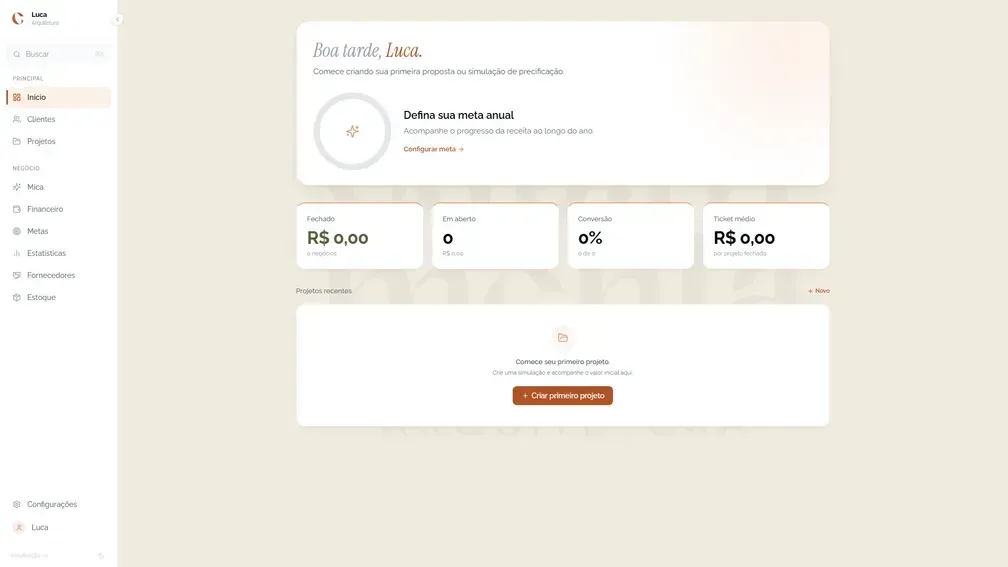
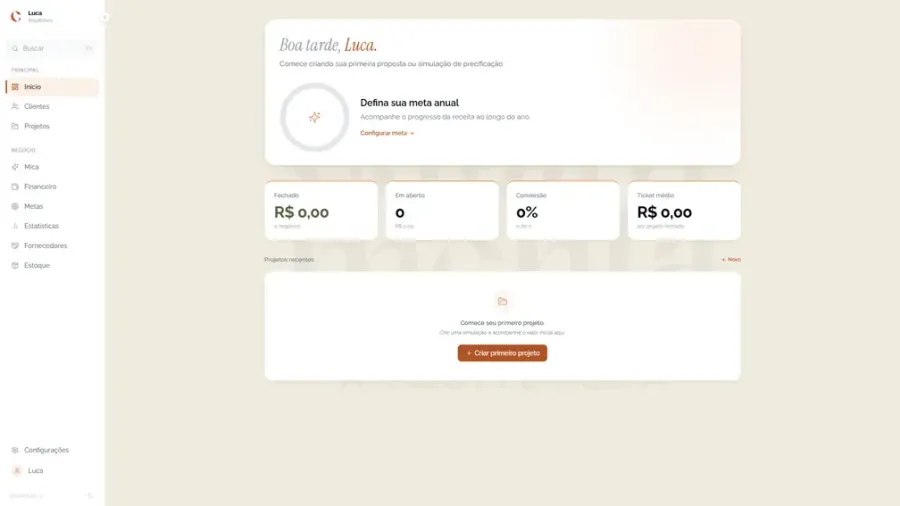
It is now the application the studio opens in the morning, on desktop and on iPad, with an interface entirely in Portuguese — it is used by people doing their jobs, not by people evaluating software.
Inside it
Six parts, one record of the studio.
- Proposals
- The original job, and still the centre of it. A project’s parameters become a price, and the price becomes a document the studio can put in front of a client without retyping anything.
- Clients
- Every client and every project in one place, so a proposal is written against a record rather than against memory.
- Finances
- What has been quoted, what has been agreed, and what has actually come in — the three numbers a studio needs and the three that are easiest to lose track of.
- Goals
- An annual target the studio sets, with progress measured against the work that is actually closed rather than the work that is hoped for.
- Mica
- An assistant built on the Claude API, working against the studio’s own data rather than against a blank page.
- Documents
- PDFs generated in the browser with pdf-lib, so a proposal is produced on demand and never depends on a server being awake.
Confirm what Mica actually does day to day — drafting proposal text, answering questions about the studio's own data, something else. The description above is deliberately general because I would rather say less than say something inaccurate.
White label
One codebase, more than one studio.
Built for one studio, the platform describes a problem every small studio has. So it was separated: what is Capim Menta — the name, the colours, the data — was pulled out of the application and turned into configuration, leaving behind a product another studio can run as its own.
The constraint is that this cannot be skin deep. Two studios sharing a deployment must never see each other's clients or finances, and that has to hold in the database rules rather than in the interface — the interface being the part an attacker does not have to use.
Confirm whether the second studio is live yet, and whether tenants are separated by deployment or share one. I have described the shape of the architecture without claiming a launch that may not have happened.
Stack
What it is made of.
- Interface
- React TypeScript Vite Tailwind CSS
- Platform
- Firebase Auth Cloud Firestore Cloud Functions Hosting
- Generation
- Claude API pdf-lib
Firebase carries the whole back end, which for a studio-sized product is the right trade: no servers to keep alive, and the access rules sit with the data instead of in a layer in front of it. pdf-lib generates documents in the browser, so producing a proposal costs nothing and works whether or not anything else is reachable.